This autumn marks a turning point in the malicious use of agent-based penetration testing frameworks, particularly ARTEX. This open-source project, released last July by a Chinese cybersecurity researcher, has seen a rapid increase in attacks using this framework, orchestrated by actors with surprisingly diverse profiles. The more than twenty public threat reports already published on this topic include state intelligence services, Cambodian criminal networks, anonymous opportunists, and others.
But how exactly do we know who is pulling the strings behind the scenes at ARTEX? At first glance, the technical signatures seem identical. We find common basic methods such as burst requests, characteristic User Agents (`artex-enrich/1.0`, `artex-selfupdate`, `artex-pentest/1.0`, etc.), and a systematic reliance on classic web vulnerabilities. What changes is the objective, the purpose assigned to the agents.
A variable depth of attack…
Thus, for some cybercriminals, the approach is purely transactional: they are looking for a specific artifact, such as a PKCS#12 certificate and its password. In these campaigns, the agent is a rapid collector. It deploys no malware, seeks no persistence, and disappears as soon as the target is acquired. It's a "steal and go" attack, even if it leaves behind some rather noisy traces.
Other players use ARTEX to tackle business processes. This is the case for Crafty Falcon, This modus operandi targeted Indian financial institutions. Here, the attacker doesn't just scan the surface; they infiltrate the transfer processes, executing micro-transactions of one rupee before initiating mass transfers. By abusing settlement/liquidation APIs from within the victim's own infrastructure, the attacker bypasses whitelists and KYC controls. ARTEX—which in this modus operandi is combined with other frameworks like PentAGI, Cairn, and CyberStrikeAI—allows access to the core transactional processes of the enterprise.
…and a sometimes high level of sophistication
When used for espionage, the framework allows for even deeper penetration. VAPOR PANDA, This is a state-sponsored modus operandi originating in China, and its objective is long-term access. The agent does not simply exploit a vulnerability; it deploys webshells, exploits local administrator passwords for Windows Active Directory (LAPS), and installs a dedicated backdoor via DLL sideloading. This results in an extremely sophisticated level of post-exploitation and EDR evasion, dictated directly by the operator's instructions in the prompt.
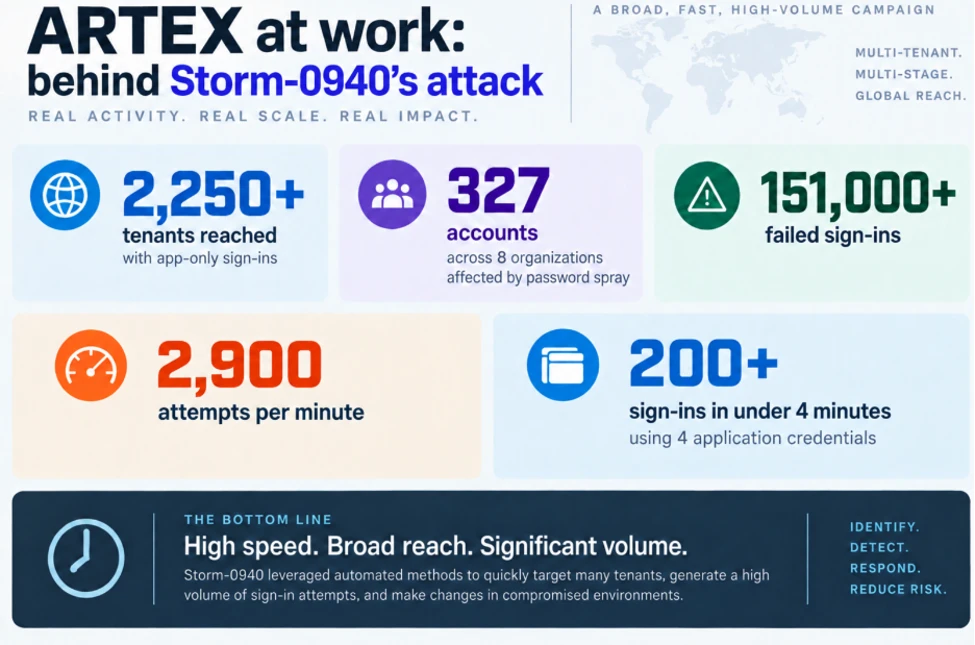
Between these extremes, we find operations such as that of Storm-0940, where the goal is privileged access to the cloud. By leveraging a software supply chain compromise, the attacker skips the vulnerability exploitation step to directly manipulate OAuth credentials, achieving a privilege level in less than three hours, without ever touching an endpoint.
The context reveals all the secrets of the attack… for now.
We can see, therefore, that while the general tool used is the same, the way it is orchestrated and deployed is very specific. One will use a pool of 272,000 residential proxies to mask its origin, while another will rely on the manipulation of Entra ID primary services. This specificity can, moreover, be read like a novel in the agents' memories. This is what the Amazon MadPot honeypots which simulate LLM inference endpoints to act as a sinkhole. Because agentic frameworks return the entire conversation history with each inference call to maintain context, it was possible to recover the entire attack thread. Amazon's report then reveals gradation instructions (L0, L2, L3) for sorting stolen keys, or "red lines" prohibiting access to government domains. Operator instructions, sometimes explicitly marked in Chinese, transform the inference traffic into a veritable campaign log.
This visibility, however, is precarious. The success of honeypots like MadPot relies on the current verbosity of agents, which still carry all their memory and the human instructions they need to function. But as the degree of agent autonomy increases, the "human in the loop" risks disappearing from the interactions. They will only set high-level objectives, which will be buried in the agent's deep memory through caching and condensation mechanisms, and will no longer appear explicitly in API requests. The inference flow will then become purely tactical and technical. The honeypot will no longer see the "why" (the operator's intention and hesitations), but only the "how" (the agent's decisions). Understanding the opposing strategy will then become more difficult.
How Intrinsec protects you against the emergence of autonomous agents
Testing before the attacker: the "Agent-Centric" approach«The rise of agent-based attacks renders traditional security audits insufficient. Our teams Audit and offensive security We now simulate "augmented" attack scenarios, using frameworks and agents similar to those used by adversaries. We test the resilience of your environments to identify and remediate critical access paths before an autonomous agent can discover them.
Detecting the invisible: behavioral and contextual monitoring: Faced with attackers who automate reconnaissance and exploitation, static analysis is obsolete. Our SOC and our MDR services deploy contextual monitoring capable of spotting early signs of an agent-driven intrusion, even when the malware uses generic tools or adapts in real time to bypass defenses.
Anticipating changes in operating methods via CTI The emergence of offensive AI is transforming the speed at which threats spread. Our team of Cyber Threat Intelligence We continuously analyze new attack frameworks and the vulnerabilities of autonomous agents to transform this intelligence into actionable detection rules. We help you shift from a reactive, patch-based approach to a proactive attack surface reduction strategy.
The strength of our approach lies in the interconnectedness of these areas of expertise: CTI identifies new offensive AI tools, offensive security validates their impact on your infrastructure, and the SOC provides continuous monitoring. A complete cycle to counter a threat that is constantly accelerating.