A security team rarely suffers from an intelligence deficit. It suffers from an operational deficit. The flows exist, the reports arrive, the metrics circulate, and yet the data doesn't always reach the point where a decision is made. The OpenCTI connector that our Cyber Threat Intelligence unit has just published for DDoSia configurations illustrates this last mile work, the one that separates an accessible source from actually usable intelligence.
The signal: what the DDoSIA configurations say
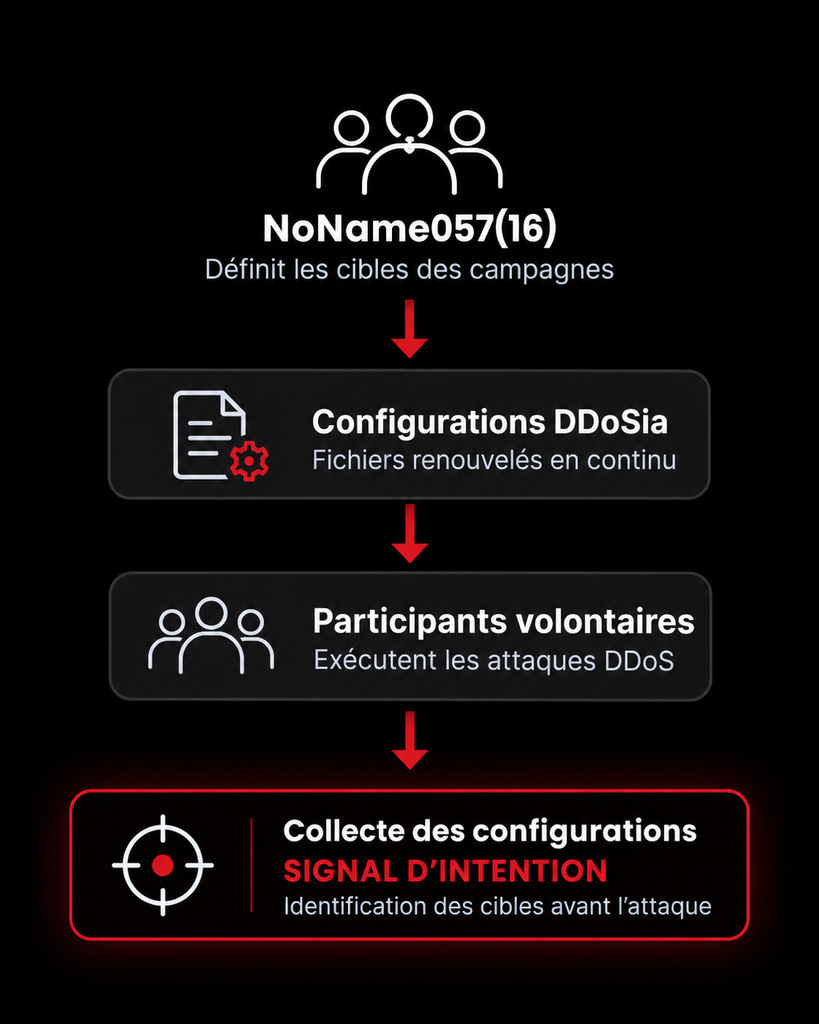
The NoName057(16) collective has been conducting distributed denial-of-service (DDoS) campaigns against European targets, including numerous French entities, both public and private, for several years. These campaigns rely on DDoSia, a tool distributed to volunteer participants who contribute their bandwidth to the operation.
The way this tool works has a valuable feature for defense. Participants do not choose their targets: they receive configuration files that designate them, and these files are continuously renewed according to the collective's slogans.
Collecting these configurations is therefore akin to reading, almost in real time, the list of selected targets. The benefit for a security manager is immediate. It's not an indicator of compromise discovered after the fact, but a signal of intent: which sectors are targeted, what wave of attacks is being prepared, and, if applicable, whether their own assets are on the list.
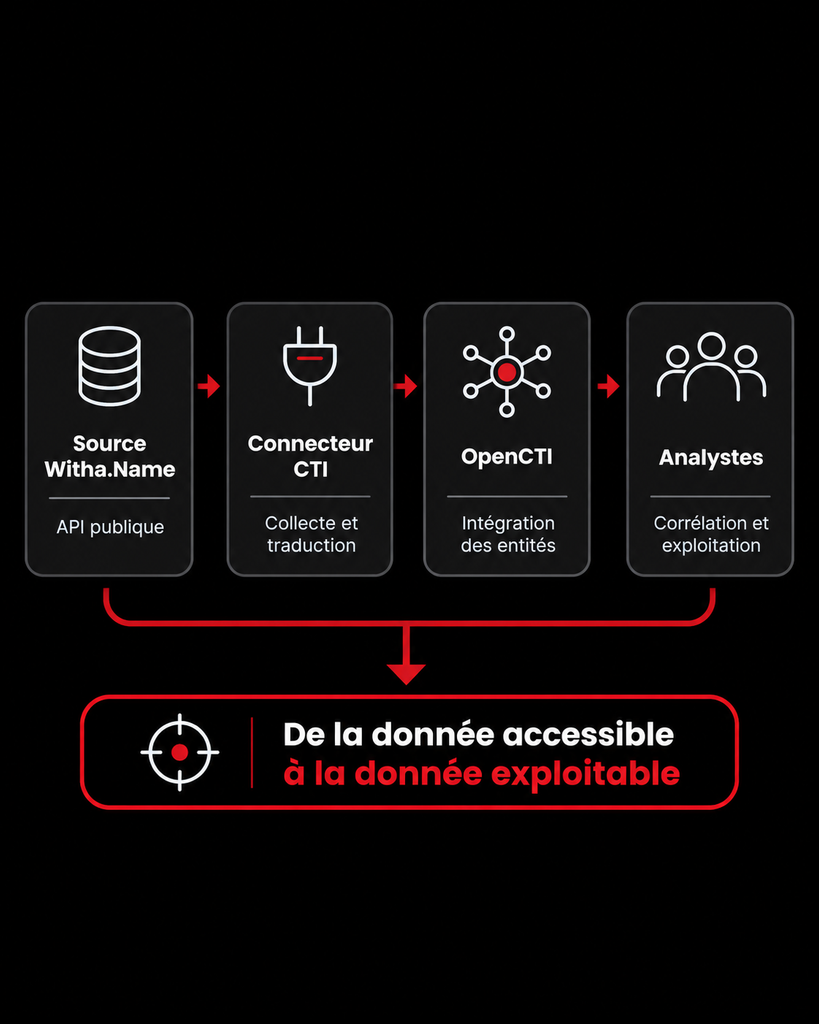
This signal is public. A security research group, Witha.Name, collects and makes available the feed of indicators related to NoName057(16). Intelligence here is not about privileged access. It's about exploitation.
The sticking point: an accessible source is not an integrated source
This is where most systems falter. A source available on a web page produces no defensive value until it joins the platform where analysts work, where entities are correlated, where detection rules are fed, and where alerts are instructed.
Between the two lies an engineering task that no one asks for but everyone expects: understanding the source format, extracting the relevant entities, translating them into the platform model, maintaining this translation as the source evolves, and absorbing breaks without interrupting data collection. This same requirement governs the qualification of our own intelligence flow.
This work is rarely visible. Yet it is what determines whether an intelligence flow feeds into a decision or lies dormant in a tab.
The DDoSia case provides a clear demonstration of this. Witha.Name recently opened a programming interface to facilitate data access, where previously delivery relied on CSV files. This development simplified access, but no connector existed within OpenCTI to leverage it.
Our answer: an OpenCTI connector, published on the Filigran Hub
Our Cyber Threat Intelligence team created this connector. It queries the interface set up by Witha.Name, retrieves DDoSIA configurations and integrates them into OpenCTI as entities usable by analysts.
We made it public. It is available on the Filigran Hub, That is to say, it is included in the OpenCTI vendor's own integration catalog. It installs in any OpenCTI instance, without any dependency on our own services, and the teams that use it can use it immediately.
This choice deserves an explanation, as it may seem surprising. We are publishing a tool that we could have kept. The reason is simple: a connector is not a competitive advantage. It is part of the shared infrastructure of an ecosystem in which we participate, alongside Filigran, the publisher of OpenCTI, and the researchers who maintain the source code. What cannot be copied lies elsewhere.
That which cannot be copied
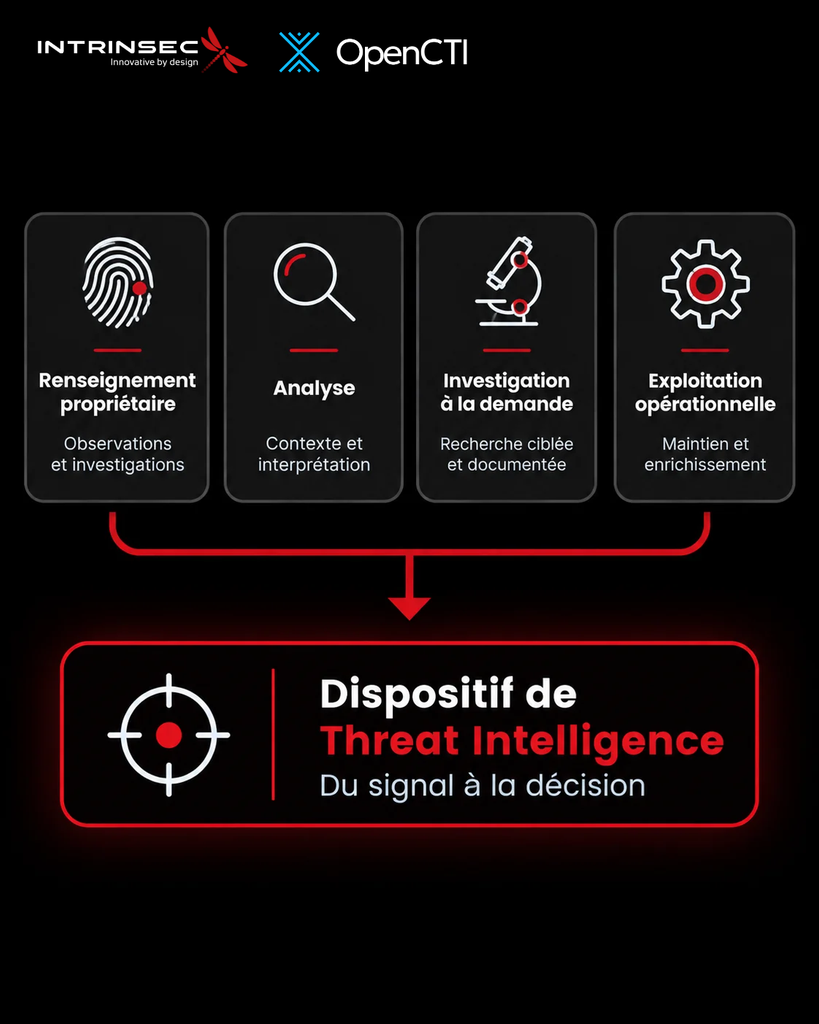
A connector carries data. It does not produce judgment or prioritization, and this is precisely where the difference lies between a data-driven platform and an intelligence device.
It consists of four elements, and they all relate to humans and long-term time.
Proprietary information, First, our analysts feed the platform with our own observations, gathered from our investigations, monitoring, and interventions with our clients. This material is not available in any public feed.
The analysis, Next, a signal is only valuable when considered within a context. Whether a target belongs to a specific sector, whether a wave follows a political declaration, whether a modus operandi shifts from one actor to another: these interpretations are the product of research, which we incorporate into our... analysis reports and in the threat search conducted for the benefit of our clients.
The investigation on demand, Again. Our clients can contact our Research and Investigation unit with a specific question and receive a documented response within a defined timeframe, rather than a generic report. When the signal becomes an incident, our teams... incident response take over on the same subject matter.
Operational operation, Finally. We are operating the threat intelligence platform for organisations that do not wish to bear the burden, and we ensure the maintenance, enrichment and production of the analysis reports.
In practice
The connector is available on the Filigran Hub.
If you are already using OpenCTI, you can install it now in your instance and start using DDoSia configurations.
If you would like to examine how our intelligence, reports and investigative unit would fit with your own use of the platform, our teams are available to assist you.