Key Points
- A penetration test offensively assesses the security of a system by simulating real attacks to identify exploitable vulnerabilities
- There are several types of penetration tests: web applications, mobile applications, APIs, IoT, internal networks, and social engineering, depending on the scope targeted.
- The approaches vary between black box (no information), grey box (partial access) and white box (full access) depending on the level of information provided
- Penetration testing is mandatory to obtain certain certifications such as ISO 27001, SOC2, PCI DSS and HDS
- The final report classifies vulnerabilities by criticality and proposes concrete recommendations for remediation with a priority action plan.
What is a penetration test and why is it essential?
A penetration test, commonly known as a pentesting, is an offensive security assessment that closely replicates the behavior of a real attacker. This controlled simulation allows organizations to identify exploitable vulnerabilities before malicious hackers can use them to compromise their IT systems.
The main objectives of a pentesting They aim to identify vulnerabilities, technical flaws, and misconfigurations that compromise the confidentiality, integrity, and availability of sensitive data. Unlike automated scanners that only detect known vulnerabilities, a professional penetration test reveals logical flaws and access rights issues that traditional tools cannot automatically detect.

The current regulatory environment reinforces the importance of penetration testing. Customers, partners, and certification bodies increasingly demand tangible proof of information system security.
This economic reality is pushing companies to adopt a proactive approach to cybersecurity, where penetration testing becomes a strategic investment rather than a simple compliance obligation.
The different types of penetration tests depending on your infrastructure
The diversity of modern IT systems necessitates specialized approaches to effectively assess each security layer. Each type of penetration test addresses specific business challenges and covers a distinct technical scope.
| Type of Pentest | Perimeter | Typical Duration |
|---|---|---|
| Web Application | Websites, portals | 5-8 days |
| Mobile | iOS/Android Apps | 8-12 days |
| API | REST/GraphQL Services | 3-6 days |
| IoT | connected objects | 10-15 days |
| Internal Network | IT Infrastructure | 10-20 days |
| Social Engineering | Human factor | 5-10 days |
Web application penetration testing
Web application penetration testing focuses on identifying vulnerabilities from the OWASP 2023 Top 10 list, including SQL injection, failed authentication, and exposure of sensitive data. This approach also assesses server configurations, cloud environments, and all implemented application security measures.
Evaluating logical flaws and permission issues specific to business applications is a crucial aspect often overlooked by automated scanners. These tests cover all modern technologies: PHP, .NET, Java, Python, as well as JavaScript frameworks like React and Angular.
A typical web application penetration test reveals an average of 15 to 25 vulnerabilities, of which 2 to 4 are classified as critical and require immediate remediation. The most frequently discovered flaws include SQL injection, XSS vulnerabilities, and session management issues.
Mobile application penetration testing
A mobile application security audit combines static and dynamic analysis to cover the entire attack surface. Static analysis enables code extraction and reverse engineering for Android and iOS, revealing vulnerabilities present in the application's source code itself.
Dynamic analysis performs runtime tests on emulators and physical devices, simulating real-world usage conditions. This approach systematically includes auditing the APIs and backend servers associated with mobile applications, as mobile security depends entirely on the complete ecosystem.
Commonly discovered vulnerabilities include vulnerable local storage of sensitive data, unencrypted communications with servers, and bypassing client-side security controls. A professional mobile penetration test also assesses resilience against application modification and malicious code injection techniques.
Pentesting of APIs and web services
Testing REST, GraphQL, and SOAP API interfaces requires specialized expertise because these services often form the core of modern architectures. Verifying authorization controls and access rights management frequently reveals vulnerabilities that allow unauthorized access to sensitive data.
Detecting excessive data exposure and authorization abuse is a major challenge, as APIs often expose more information than necessary to function correctly. These tests can be integrated into web or mobile penetration tests, depending on the overall information system architecture.
API vulnerabilities now account for more than 40% of security incidents in enterprises using microservices architectures, making these audits absolutely critical to overall security.
IoT and connected object penetration testing
Multi-layered auditing of connected devices covers hardware, firmware, radio protocols, and associated applications. This holistic approach is necessary because the security of an IoT ecosystem depends on each component of the technology chain.
Testing for hardware vulnerabilities and potential backdoors often reveals fundamental flaws in device design. Analysis of Bluetooth, Wi-Fi, LoRaWAN, and Zigbee communication protocols frequently uncovers vulnerable implementations or insecure default configurations.
A comprehensive assessment of the connected ecosystem necessarily includes the cloud and mobile applications, as an isolated connected object does not exist in reality. This complexity explains why IoT penetration tests generally require more time and specialized expertise.
Internal network penetration test
Simulating an attacker gaining initial access to the company's local network allows for the assessment of an intrusion's propagation potential. These tests examine servers, network equipment, workstations, and Active Directory to identify privilege escalation paths.
Lateral movement analysis demonstrates how an attacker can progress through the infrastructure after the initial compromise. Wi-Fi auditing and network segmentation reveal opportunities to limit the spread of attacks through an appropriate defensive architecture.
A typical internal network penetration test discovers vulnerabilities allowing full administrator access in less than 48 hours in 70% cases, highlighting the critical importance of defense in depth.
Social Engineering Pentest
Human resilience tests include phishing, vishing, smishing, and physical intrusion attempts to assess the human element in the security chain. Evaluating employee awareness of cyber threats often reveals significant gaps in staff training.
Simulating targeted attacks on executives and key employees allows us to measure the vulnerability of high-value profiles. These tests also measure the effectiveness of existing awareness training and identify areas for improvement.
Statistically, 851% of data breaches involve a human element, making social engineering one of the most effective attack vectors for cybercriminals.
Methodology and approaches: black box, grey box and white box
The choice of methodological approach directly influences the depth, realism, and duration of the penetration test. Each approach addresses different objectives and adapts to the specific budgetary and time constraints of each organization.
Black box penetration testing
Simulating an external attack without any prior information about the system offers maximum realism by faithfully reproducing the conditions faced by an unknown external hacker. This approach effectively tests the publicly exposed attack surface and reveals vulnerabilities visible from the internet.
The advantages include an authentic external perspective and the discovery of vulnerabilities that internal teams are unaware of. However, the disadvantages include a longer time required for reconnaissance and potentially incomplete coverage of internal systems.
This approach is particularly suitable for companies wishing to assess their exposure to external attacks and test the effectiveness of their perimeter defenses. The black box remains ideal for simulating the most common attack techniques used by cybercriminals.
Pentest in a grey box (Grey Box)
Partial access to system information, including user accounts and basic documentation, offers an optimal compromise between realism and depth of analysis. This approach simulates a malicious internal user or an external attacker who has obtained preliminary information.

The gray box approach is recommended for most organizations because it maximizes vulnerability discovery while maintaining a reasonable budget. This method allows for the rapid identification of critical vulnerabilities without wasting time on exhaustive reconnaissance phases.
Companies typically obtain 30% additional vulnerabilities with a grey box approach compared to a black box approach, while reducing the test duration by 20 to 25%.
White box penetration testing
Full access to the source code, technical documentation, and administrator privileges enables a comprehensive analysis capable of detecting even the deepest and most complex vulnerabilities. This approach optimizes time thanks to a complete understanding of the system architecture.
The white box method is ideally suited for code auditing and security validation before deploying new applications to production. This method reveals subtle logical vulnerabilities and design flaws that are difficult to detect with other approaches.
The effectiveness of this approach makes it particularly suitable for DevSecOps development cycles where security must be naturally integrated into continuous delivery processes.
The 4 essential phases of a successful penetration test
The standardized methodology based on PTES (Penetration Testing Execution Standard) and OWASP guarantees the quality, reproducibility, and completeness of penetration tests. Each phase produces specific deliverables and requires dedicated resources to maximize efficiency.
Phase 1: Reconnaissance and information gathering
Open-source intelligence (OSINT) gathering is the foundation of any effective penetration test. This phase identifies domains, subdomains, IP addresses, and all publicly available information about the target. Identifying the technologies used and exposed third-party components guides subsequent phases toward the most promising attack vectors.
The search for leaks of sensitive public data and information often reveals critical elements such as usernames, passwords, or architectural details. This phase typically represents 10 to 20% of the total time, depending on the approach chosen, but its impact on the overall effectiveness of the test remains crucial.
Penetsters use advanced OSINT techniques including social media monitoring, analysis of public document metadata, and searching databases of past breaches.
Phase 2: Mapping and enumeration of the system
The complete mapping of all discovered features and services creates an exhaustive database of elements to be tested. The enumeration of ports, services, and software versions reveals the actual attack surface and guides test prioritization.
Identifying potential entry points and creating a detailed map allows for the optimization of subsequent phases. This critical step determines the quality and completeness of the entire penetration test.
The enumeration phase uses tools like Nmap for network discovery, supplemented by specialized manual techniques depending on the identified technologies. This hybrid approach ensures maximum coverage without generating false positives.
Phase 3: Discovery and analysis of vulnerabilities
The combination of automated tools and specialized manual testing is at the heart of the added value of a professional penetration test. Searching for technical, logical, and configurational vulnerabilities requires irreplaceable human expertise to identify complex flaws.
Manual validation of vulnerabilities detected by automated scanners eliminates false positives and confirms the actual exploitability of the vulnerabilities. This phase represents 50 to 60% of the total time and directly determines the quality of the final deliverable.
Penetration tests reveal an average of 40% more vulnerabilities through manual testing compared to automated scans alone. This difference fully justifies the investment in qualified human expertise.
Phase 4: Exploitation and impact assessment
Controlled vulnerability exploitation measures the real-world impact and demonstrates the feasibility of attacks with concrete proofs of concept. This demonstration helps technical teams understand the risks and prioritize remediation.
Searching for additional vulnerabilities through side effects often reveals cascading flaws that are not individually detectable. Business risk assessment and criticality classification guide the remediation plan toward the most impactful actions.
This final phase transforms technical discoveries into actionable recommendations, bridging the gap between technology and business challenges.
Tools and technologies of modern pentesting
The evolution of penetration testing tools towards automation and integration into DevSecOps pipelines improves efficiency without replacing human expertise. Modern tools amplify the capabilities of experts rather than substituting for them.
Burp Suite Professional: the benchmark for web applications
The integrated web proxy intercepts and modifies HTTP/HTTPS requests/responses in real time, enabling detailed manual analysis of communications. The built-in automated scanner effectively detects OWASP Top 10 vulnerabilities with a low false positive rate.
Community extensions via Burp Extender add advanced features tailored to the specific needs of each test. The intuitive interface facilitates the transition between manual and automated testing, optimizing penetration testing productivity.
Burp Suite Professional remains the reference tool for 90% for professional pentesters according to industry surveys, confirming its dominant market position.
Exegol: Containerized penetration testing environment
This optimized Debian distribution includes over 400 pre-installed and pre-configured tools, eliminating compatibility and installation issues. Rapid deployment via Docker creates reproducible, isolated environments for every mission.

Continuous tool updates and the regular addition of new features keep the environment state-of-the-art. This solution is ideal for getting started in penetration testing or standardizing the environment for an entire team.
Exegol reduces test environment preparation time by 80% compared to a traditional manual installation, freeing up time for value-added activities.
SQLMap: SQL injection specialist
The complete automation of SQL injection detection and exploitation covers six major DBMSs: MySQL, PostgreSQL, Oracle, SQL Server, SQLite, and Access. Advanced techniques include blind SQL injection, time-based injection, and boolean-based injection to bypass modern protections.
Data extraction and system command execution capabilities transform an SQL vulnerability into a complete compromise of the underlying system. This capability demonstrates the real impact of injection vulnerabilities on business teams.
SQLMap remains the reference tool for exploiting SQL injections, with over a million documented uses and an active community of contributors.
Pentest report and action plan
The professional structure of the final report determines the effectiveness of the remediation and the understanding of the issues by management teams. A well-designed report transforms technical findings into actionable business plans.
Vulnerability classification and prioritization
The standard criticality scale comprises five levels: Critical, High, Medium, Low, and Informative. The evaluation criteria combine ease of use with the impact on data confidentiality, integrity, and availability.
Taking into account the business context and actual exposure modulates the theoretical criticality according to the organization's specific challenges. The remediation plan proposes recommended timeframes: 0-7 days for critical vulnerabilities, 1-3 months for high-risk vulnerabilities, and 3-6 months for medium-risk vulnerabilities.
| Critical | Correction Deadline | Business Impact | Typical Examples |
|---|---|---|---|
| Critical | 0-7 days | Complete compromise | SQL Injection, RCE |
| High | 1-3 months | Unauthorized access | Stored XSS, CSRF |
| Average | 3-6 months | Information leak | Version Disclosure |
| Weak | 6-12 months | Limited impact | Minor configuration |
Technical and organizational recommendations
Specific technical fixes accompany each identified vulnerability, along with code examples and references to best practices. System architecture and hardening recommendations offer structural improvements to enhance overall security.
Enhanced secure development processes (DevSecOps) integrate security into delivery cycles to prevent the reintroduction of similar vulnerabilities. Training and awareness programs for technical teams and users complement the technical measures with a human element.
Organizational recommendations include the implementation of security policies, the definition of incident management processes, and the establishment of metrics to monitor security posture.
Compliance and certifications: penetration testing is mandatory
Regulatory requirements vary across industries, but the general trend is to conduct regular penetration tests to maintain critical certifications. The recommended frequency typically follows an annual cycle, with additional testing following major changes.
ISO 27001 and safety management
The requirement for regular penetration testing in Annex A.12.6.1 is part of the PDCA (Plan-Do-Check-Act) continuous improvement process. Documenting the results for certification audits requires a specific level of detail and traceability.
The recommended annual frequency maintains certification validity while allowing for continuous improvement of security posture. Certification bodies systematically verify the execution and quality of penetration tests during surveillance audits.
The ISO 27001 standard now covers more than 50,000 certificates worldwide, making penetration testing mandatory for a growing number of organizations.
PCI DSS and payment data protection
Requirement 11.3 mandates annual penetration testing for all entities handling payment card data. Testing after significant infrastructure changes ensures ongoing compliance.
Qualified penetration testers (ASV - Approved Scanning Vendor) or qualified security assessors (QSA - Qualified Security Assessor) are recommended to ensure that results are recognized by payment agencies. The specific documentation required for compliance reports follows strict standardized formats.
Failure to comply with PCI DSS requirements exposes companies to fines of up to €500,000 per month, more than justifying the investment in regular penetration tests.
HDS and health data hosting
The integration of penetration testing into the HDS 2018 framework addresses the critical challenges of protecting health data. Assessing the security of systems processing this sensitive data requires specific expertise in the healthcare sector.
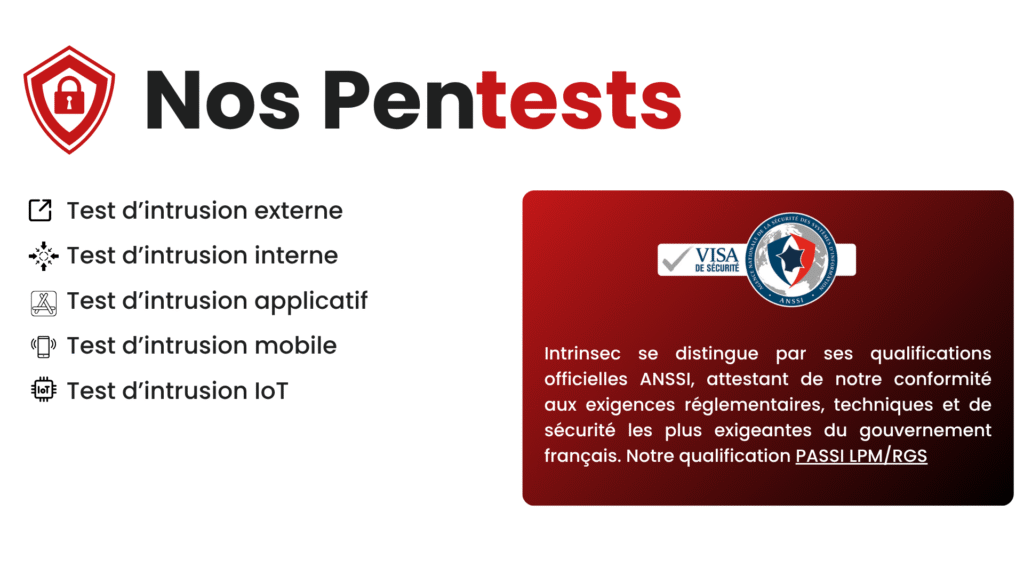
PASSI-certified (Information Systems Security Audit Provider) providers are recommended to ensure regulatory recognition of audits. Renewal every 3 years with annual updates maintains the validity of HDS hosting.
Choosing your pentesting provider
The criteria for selecting a qualified service provider include certifications, methodology, team experience, and verifiable client references. These elements directly determine the quality and value of the final deliverables.
Certifications and qualifications to look for
The PASSI qualification for public organizations guarantees compliance with French state security standards. Individual OSCP, OSEP, and CISSP certifications held by consultants demonstrate their personal technical expertise.

The budget required varies from €8,000 to €40,000 depending on the type and complexity of the penetration test. Factors influencing the price include the time required, the expertise needed, the level of urgency, and the provider's certifications.
FAQ – Frequently Asked Questions about Pentests
What is the difference between a penetration test and a vulnerability audit?
A vulnerability assessment primarily uses automated scanners to quickly identify known flaws, while a penetration test combines automated tools and human expertise to discover complex vulnerabilities and test their actual exploitability. The penetration test includes a manual exploitation phase that allows for measuring the concrete impact of the flaws and identifying attack chains that are not automatically detectable.
How long does a penetration test last and how often should it be repeated?
The duration varies from 5 to 20 days depending on the scope: 5-8 days for a web application, 10-15 days for a complete network infrastructure. It is recommended to perform a penetration test annually or after any major infrastructure change. For certifications such as PCI DSS, an annual penetration test is mandatory, while ISO 27001 recommends regular testing based on risk analysis.
What budget should be planned for a penetration test in 2025?
Pricing varies depending on the complexity and environment being tested: simple web application penetration testing, average network infrastructure, comprehensive multi-perimeter audit, etc. Factors influencing the price include the number of person-days required, the expertise needed, the level of urgency, and the provider's certifications. Penetration tests performed by service providers PASSI offer regulatory recognition.
Can a penetration test damage my production systems?
A professional penetration test minimizes risks through rigorous methodology and non-destructive tools. However, temporary interruptions or performance degradation may occur when exploiting certain vulnerabilities. An audit agreement clearly defines responsibilities and limitations, and it is recommended to schedule tests during periods of low activity and prepare business continuity plans.
How to effectively use the results of a penetration test?
The penetration test report should be treated as a prioritized action plan: first, fix critical vulnerabilities (0-30 days), then high-risk (1-3 months), and finally medium-risk (3-6 months). It is essential to involve technical teams in understanding the vulnerabilities, implement a system for tracking fixes, and schedule regression testing. Raising awareness among teams about the discovered vulnerabilities strengthens the security posture over the long term.